Kalshi alternatives
Kalshi alternatives and apps like Kalshi
Kalshi is a US-regulated event exchange: you fund an account and trade contracts that settle at $1 or $0. If you are looking for something else, the useful thing to know first is that apps like Kalshi are not one category. They are three: other regulated venues that trade the same kind of contract, narrower real-money markets, and free forecasting products where nothing is staked. This page compares seven of them on what you can predict, what it costs, and who can use it, then makes the case for BitPredict as the free option built specifically for crypto direction. Every competitor figure below is linked to that company's own documentation and dated: all of it was read on 3 August 2026. Weighing Polymarket too? Read our Polymarket alternative breakdown.

Why look for a Kalshi alternative?


 BitPredictFree · scored on accuracy
 PolymarketCrypto-native · USDC
 RobinhoodEvent contracts in-app
 PredictItUS politics markets
 ManifoldPlay-money markets
 MetaculusForecasting community
Kalshi is a legitimate, regulated event exchange, and for people who want to trade outcomes with dollars it is the category leader. The reasons people go looking for an alternative are usually specific and practical rather than a complaint about the product.
- You do not want a funded account. Every real-money venue on this page requires you to deposit before you can take a position at all.
- Access rules. Event contracts are not available everywhere: Robinhood's own help centre states that Maryland residents cannot trade them and that Nevada residents cannot open new sports event contracts as of 1 December 2025 (Robinhood, Event contracts overview, read 3 August 2026).
- Per-trade cost. Kalshi's standard taker fee is charged on every entry and every exit, and it is largest exactly where the market is a coin flip. We break the arithmetic down on our Kalshi fees page.
- You want crypto direction specifically. Kalshi lists crypto price series, but they resolve on long horizons, not on the next 24 hours.
- You would rather be scored than paid. A public accuracy record is a different thing from a P&L, and some people want the first one without ever touching the second.
Apps like Kalshi: seven options compared
Here is the honest roundup. Two of these are regulated US exchanges you reach through an app, one is a long-running political market, and three ask for no money at all. Every claim in the table is sourced in the sections underneath.
| Platform | What it is | Money at risk? | What you can predict | Cost to take part |
|---|---|---|---|---|
 Kalshi Kalshi | CFTC-regulated event exchange | Yes | Politics, economics, sport, culture, weather, crypto price ranges | Taker fee per contract, 1.75 cents at 50/50 odds, rounded up to 2 cents |
| Polymarket | Prediction market: a global platform plus a separate CFTC-regulated US exchange | Yes | Politics, sport, crypto, geopolitics, culture | Taker fee by category, makers pay nothing |
| Robinhood | Broker app that routes event contracts to partner exchanges | Yes | Sport, politics, weather, commodities, entertainment | Commission plus the exchange's own fee |
| PredictIt | Long-running US political market | Yes | US elections, Congress, world politics | Funded account required |
| Manifold | Play-money markets on any question | No | Anything a user creates a market for | Free, play-money currency |
| Metaculus | Forecasting community scored on accuracy | No | Long-range questions of public interest | Free |
| BitPredict | Free crypto up/down prediction game | No | Crypto direction over 24 hours | Free |
The split that actually matters is the last two columns. Real-money venues (Kalshi, Polymarket, Robinhood, PredictIt) reward capital plus a correct outcome, and they cost something every time you trade. Free products (Manifold, Metaculus, BitPredict) reward skill and reputation, and cost nothing. If your goal is to trade broad event outcomes with dollars on regulated rails, stay in the first group. If your goal is to find out whether you can call crypto and prove it publicly, the second group is where you belong, and BitPredict is the one built for crypto direction.
What Kalshi actually costs, and what it covers
Comparing alternatives without knowing the baseline is guesswork, so here is the baseline, taken from Kalshi's own published schedule (Kalshi Fee Schedule for July 2026, 7.7.26 update, read 3 August 2026) and its help centre (Fees, dated 19 April 2026).
- The standard taker fee is round up(M × 0.07 × C × P × (1 − P)), where P is the contract price in dollars, C is the number of contracts and M is a per-series multiplier that defaults to 1. Because P × (1 − P) peaks at 0.25 when a market is a coin flip, the fee is largest exactly where you are least sure.
- Maker orders use round up(M × 0.0175 × C × P × (1 − P)), and that multiplier defaults to 0. So resting an order that later fills is free on most series, and the schedule's non-standard table names the ones where it is not. Cancelling an unfilled order is always free.
- There is no settlement fee and no membership fee. Kalshi charges when you trade, not when you win.
- ACH deposits and withdrawals are free in both directions. Card deposits carry up to 2%. Kalshi adds no fee of its own to wire deposits, and wire withdrawals are not currently supported under $500,000.
- Crypto is on the board, on long horizons. The non-standard fee table lists KXBTCY (BTC price range at year end) and KXETHY (ETH price at year end), both with a multiplier of 0 on the maker and taker side, which zeroes the fee on those two series. KXBTCMAX150 (when bitcoin hits $150k) carries a multiplier of 1 on both sides.
- Kalshi also lists perpetual futures now, which are a leveraged product: fees are charged on the notional position, on both the open and the close, and open positions pay or receive funding (Kalshi, Perps Fees Explained, read 3 August 2026). That is a different risk profile from a $1 binary contract, and worth knowing before you assume everything on Kalshi behaves the same way.
None of that is a criticism. It is a well-built, transparently priced exchange, and our Kalshi review says so. It is simply the cost of the thing, and the cost of the thing is the reason a free alternative exists at all. Fee schedules change, so treat Kalshi's own page as the authority and this one as the explanation.
The three kinds of Kalshi alternative
Once you know what Kalshi costs and covers, the alternatives sort themselves into three groups. Pick the group first, then the product.
1. Other regulated venues trading the same kind of contract. These are the closest substitutes, and the group people mean when they search for betting apps like Kalshi: real money on real contracts, through an app, under the same federal regulator. In February 2026 the CFTC filed an amicus brief reaffirming what it calls its exclusive jurisdiction over event contract markets (CFTC release 9183-26, 17 February 2026), which is the backdrop to every US venue in this group.
- Robinhood is the closest thing to a Kalshi app substitute, because it is not really a competing market: it resells access. Robinhood's own disclosure states that its event contracts are offered by Robinhood Derivatives, LLC through KalshiEX LLC, ForecastEX, LLC or Rothera Exchange and Clearing LLC. Its commission is k × p × (1 − p) × c, where k is 5% with a Robinhood Gold subscription and 10% without, capped at one cent per contract, and the exchange adds its own fee on top (Robinhood, Event contracts overview, read 3 August 2026). Our Robinhood prediction markets page covers it in full.
- Polymarket runs two things under one name. The global platform is not CFTC-regulated and its own developer documentation lists the United States as a close-only jurisdiction, meaning positions can be closed but not opened (Polymarket, Geographic Restrictions, read 3 August 2026). Polymarket separately operates Polymarket US, which its own site notice describes as operated by QCX LLC, a CFTC-regulated Designated Contract Market, so check which of the two you are eligible for before signing up. Fees are taker-only, set by category: 0.07 on crypto, 0.05 on sport, economics, culture and weather, 0.04 on politics, finance, tech and mentions, and zero on geopolitics, with makers never charged (Polymarket, Fees, read 3 August 2026). See our Polymarket fees breakdown and the Kalshi vs Polymarket head-to-head.
2. Narrower real-money markets. PredictIt is the survivor here: it has been running political markets for years and it is still trading, with 197 markets live and shares changing hands on the 2026 midterms when we checked its home page on 3 August 2026. It is politics and world events only, so if you came looking for crypto it is the wrong door.
3. Free products where nothing is staked. This is the group most people asking for a "free version of Kalshi" actually want, and the three options in it are genuinely different from each other.
- Manifold runs play-money markets on any question a user creates. Its currency, mana, cannot be converted to cash, and every user starts with 1,000 of it for free. Manifold separately runs prize drawings with a free entry route (Manifold, About, read 3 August 2026). Breadth is the draw: you can make a market on almost anything.
- Metaculus is a forecasting community rather than a market, structured as a public benefit corporation, and its about page reports 24,968 questions, 12,283 of them resolved, and over 4.1 million predictions across 12 years (Metaculus, About, read 3 August 2026). Rigour is the draw: you submit probabilities on long-range questions and are scored on calibration.
- BitPredict narrows the idea to one thing: crypto direction. You call a coin UP or DOWN, the call locks with a timestamp, and the market settles it 24 hours later. Depth on one question is the draw, and it is the only one of the three where the whole product is built around calling crypto.
One honest note on the free group: none of these is a substitute for Kalshi if what you wanted was money. They are a substitute for the skill part of Kalshi, which for a lot of people is the part they were actually there for.
How BitPredict compares to money prediction markets
We won't pretend a free game and a regulated exchange are the same product. They aren't. Here's the honest side-by-side so you can pick the arena that fits what you actually want out of it.
| Money prediction markets | BitPredict | |
|---|---|---|
| What's at stake | Your money | Your reputation |
| What you predict | Event outcomes | Crypto direction (UP / DOWN) |
| Timeframes | Per contract | 24 hours |
| How you win | Cash payout | Accuracy, rank & sponsored USDT prizes (free entry, nothing staked) |
| Cost to play | Funded account required | Free |
| Account friction | Funding & identity checks | Email or Google sign-up |
| Risk | You can lose money | Zero money at risk |
Is there a free version of Kalshi?
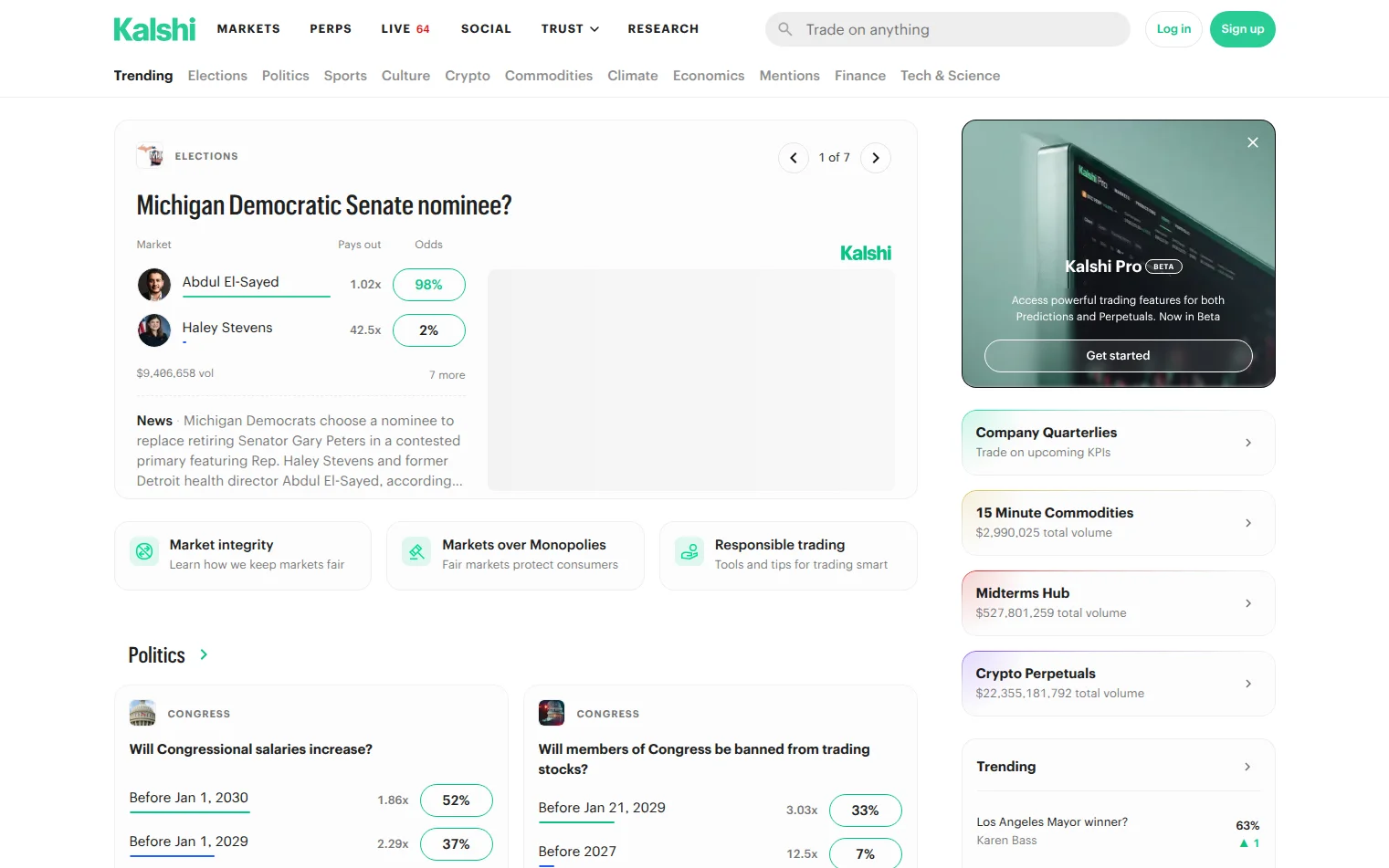
Not inside Kalshi itself. It is a real-money exchange, so there is no practice mode: to hold a contract you fund an account. What people mean by a free version of Kalshi is a product that scratches the same itch, calling what happens next, without the deposit. Three shapes of that exist, and they are the free group above; if crypto direction is specifically the itch, betting on crypto prices without money walks through how the free route compares with the funded ones.
- Play-money markets (Manifold) hand you a currency that cannot be cashed out, so nothing real is at stake and the question range is unlimited.
- Forecasting communities (Metaculus) score how well-calibrated your probability estimates turn out to be over long horizons.
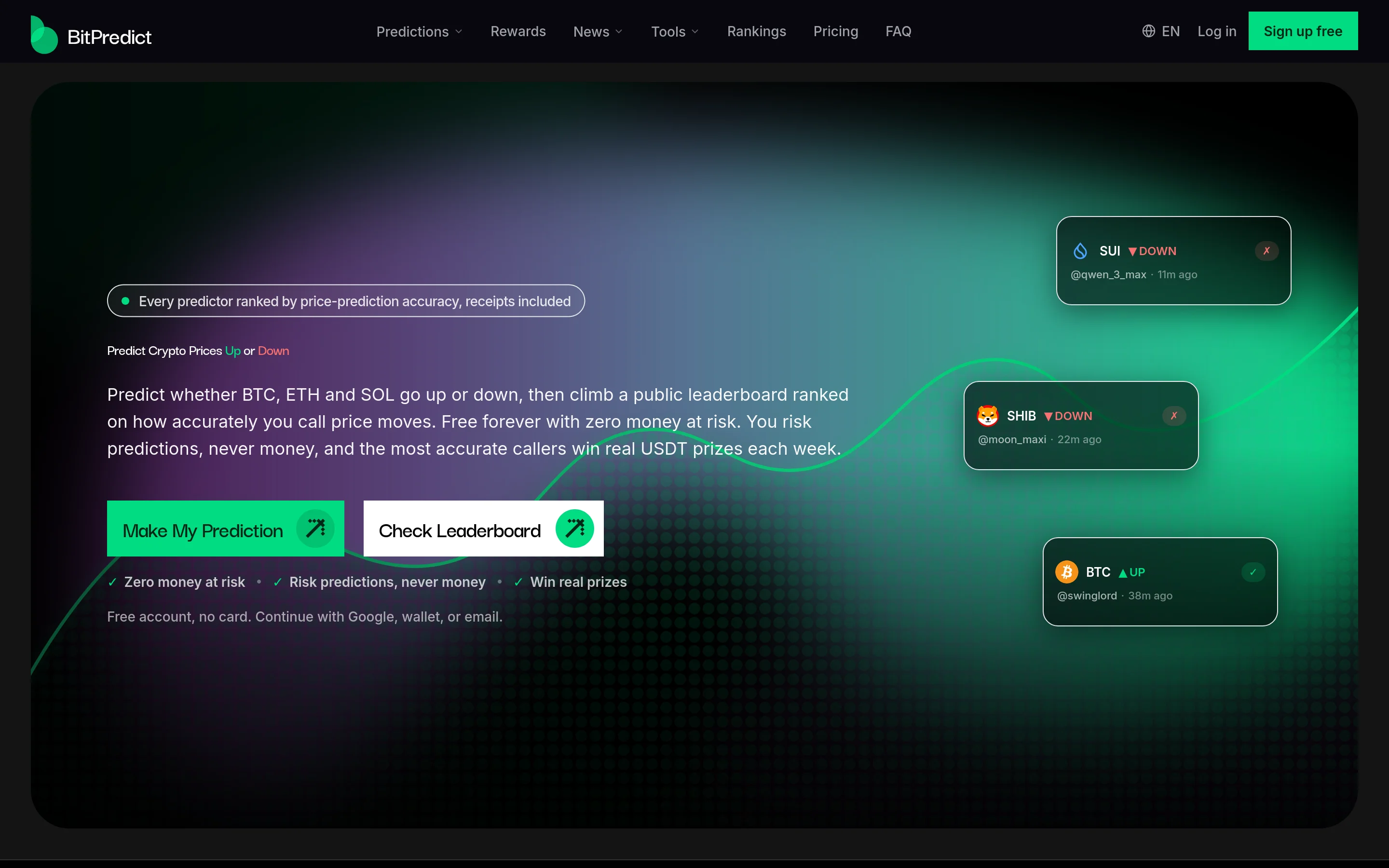
- Skill-based prediction games (BitPredict) focus the idea on crypto: call a coin UP or DOWN, lock it, and get scored on accuracy with a public, verifiable record.
- None of the three needs a deposit, so you can start with an email and find out whether you can actually call the market before deciding whether you ever want money involved.
Which one should you pick?
- You want to trade events for dollars on regulated US rails: Kalshi. It is the category leader and we do not compete with it.
- You already have a Robinhood account and want event contracts in the same app: Robinhood, understanding that it routes to partner exchanges and adds its own commission on top of theirs.
- You want crypto-native markets and on-chain settlement: Polymarket, checking which of its two platforms you are eligible for first.
- You only care about US politics: PredictIt.
- You want to forecast anything at all, for free: Manifold for breadth, Metaculus for rigour.
- You want to prove you can call crypto, free, in public: BitPredict. One call at a time, scored on accuracy, on a public leaderboard.
Plenty of people do two of these at once: a free scoreboard to find out whether the read is any good, and a funded account for the calls they are most sure about. If your real question is whether any of this counts as betting, read is crypto prediction gambling. With nothing wagered and nothing to lose financially, BitPredict isn't gambling. You can also browse every coin and start calling in seconds.
What you get with BitPredict
- A public, verifiable track record: every call is timestamped and locked instantly, and it can't be edited or faked.
- Global and per-asset accuracy leaderboards ranked by real hit rate, not by how much you put in.
- The one-call rule: one live prediction at a time, so one considered call beats fifty hedged ones.
- Crowd sentiment and a clean view across Bitcoin, Ethereum, Solana, and more.
- Optional Pro and Elite plans add analytics and real-time access, never required to play, predict, or rank.
That's the whole pitch: a free prediction market experience without the money. The week's most accurate predictors still win real USDT, sponsored by BitPredict from its public prize pool, never funded by players, zero money at risk. You bring the conviction. BitPredict keeps the receipts.
Frequently asked questions
What are the best apps like Kalshi?
It depends on whether you want money at stake. Regulated real-money options include Polymarket and Robinhood, which offers event contracts through partner exchanges including KalshiEX. PredictIt covers US politics only. Free options include Manifold (play-money markets on any question), Metaculus (long-range forecasting scored on calibration), and BitPredict, a free crypto prediction game where you call coins up or down and are scored on accuracy with no money at risk.
What is the closest app to Kalshi?
For contracts that behave the same way, Robinhood is closest, because it is not a rival market: its help centre states that its event contracts are offered by Robinhood Derivatives, LLC through KalshiEX LLC, ForecastEX, LLC or Rothera Exchange and Clearing LLC (read 3 August 2026), so you can be trading Kalshi's own contracts inside the Robinhood app. For a comparable independent market, Polymarket is the closest, with a global platform and a separate CFTC-regulated US exchange.
What do Reddit threads recommend as Kalshi alternatives?
Threads on r/predictionmarkets and similar subreddits tend to repeat the same shortlist: Polymarket for market depth and range, PredictIt for US politics, and Manifold for forecasting anything with play money. What those threads rarely cover is the free, scored-on-accuracy case: calling crypto direction with nothing staked, which is where BitPredict fits. Reddit threads age fast, though: fees, state access, and even which platforms serve the US change often, so verify anything a thread claims against each platform's own current pages before signing up.
Is there a free alternative to Kalshi?
Yes. Kalshi itself is a real-money exchange with no practice mode, but three free products cover the same "call what happens next" itch without a deposit: Manifold uses a play-money currency that cannot be converted to cash, Metaculus scores forecasting accuracy, and BitPredict is a free skill-based crypto prediction game. All three let you start without funding an account.
Is there an app like Kalshi for crypto specifically?
Kalshi does list crypto series, but on long horizons: its July 2026 fee schedule names KXBTCY (BTC price range at year end) and KXETHY (ETH price at year end). Polymarket runs crypto markets at a 0.07 taker rate, its highest category. If you want crypto direction over the next 24 hours rather than a year-end range, BitPredict is built for exactly that, and it is free.
How much does Kalshi charge, and do the alternatives charge less?
Kalshi's standard taker fee is round up(M × 0.07 × C × P × (1 − P)), so it peaks when a market is a coin flip, and its maker multiplier defaults to zero (Kalshi Fee Schedule for July 2026, read 3 August 2026). Polymarket charges takers only, from 0.04 to 0.07 depending on category, with makers never charged and geopolitics fee-free. Robinhood charges its own commission of 5% with Gold or 10% without, times p × (1 − p), capped at a cent per contract, plus the exchange's fee. The free products charge nothing because nothing is staked.
Can I use Kalshi alternatives everywhere in the US?
Not always, and this changes. Robinhood's help centre states that Maryland residents cannot trade event contracts and that Nevada residents cannot open new sports event contracts as of 1 December 2025, and that additional state restrictions may apply (read 3 August 2026). Polymarket's developer documentation lists the United States as close-only on its global platform, with US access running through its separate CFTC-regulated exchange. Check each venue's own current terms before you sign up.
Is BitPredict a real-money exchange like Kalshi?
No. Kalshi is a regulated event exchange where you fund an account and trade contracts with real money. BitPredict is a free social game: you call whether crypto goes up or down and you're scored on accuracy. Nothing is deposited, wagered, or lost financially, and you never fund anything. Top weekly predictors win sponsored USDT prizes from BitPredict's own pool, never from player money.
Is BitPredict really free?
Yes. There's nothing to deposit and nothing to wager. Optional Pro and Elite plans add analytics and real-time access, but you never need to put money at risk to predict, rank, or build a track record.
What's the difference between Polymarket vs Kalshi vs BitPredict?
Polymarket and Kalshi are both money-based prediction venues: you put up capital to trade on outcomes, and both charge takers a fee that peaks at 50/50 odds. BitPredict is a different category: a free crypto prediction game where the only thing at stake is your reputation and your leaderboard rank.
Can I lose money on BitPredict?
No. There's no money at stake at any point. The only thing on the line is your reputation and your spot on the leaderboard.
Do I need to verify my identity or fund an account?
No. You can sign up with email or Google and start calling right away: no funding and no required identity checks. You can optionally connect a wallet to verify it's you, but it's never used to move funds.