Head to head
Kalshi vs Polymarket: which one fits you?
Kalshi and Polymarket are the two names everyone weighs before trading a prediction market, and they are genuinely different products. Kalshi is a regulated US exchange where you trade event contracts in dollars. Polymarket is the crypto-native market where trades settle in USDC and the audience is global. This comparison runs both through the same criteria: regulation, funding, fees, markets, resolution and taxes. And if your honest goal is to test your read on the market rather than trade it, there is a free third option with nothing at risk.

The short answer


Both platforms let you trade on what happens next, and both are serious operations. The decision usually comes down to rails and markets: dollars on a regulated US exchange, or stablecoins on a global crypto-native market. Here is the quick version.
- Choose Kalshi if you want a US-regulated exchange, funding from a bank account in dollars, standard tax paperwork, and markets on US economics, weather and sports.
- Choose Polymarket if you are comfortable on crypto rails, want the deepest global markets on politics and world events, and would rather not pay per-trade fees.
- Choose neither if what you actually want is to test your market read without risking money. That is what BitPredict is for: free, timestamped calls scored on accuracy.
- Plenty of people use both, keeping Kalshi for regulated US markets and Polymarket for global events and crypto odds.
Kalshi vs Polymarket at a glance
The same criteria applied to both venues, with BitPredict alongside as the free, no-money reference point. It is a different category of product, and the table shows that.
 Kalshi Kalshi |  Polymarket Polymarket |  BitPredict BitPredict | |
|---|---|---|---|
| What it is | Regulated US event exchange | Crypto-native prediction market | Free crypto prediction game |
| Money at risk | Yes, your stake | Yes, your stake | No, nothing staked |
| You trade with | US dollars | USDC (a dollar stablecoin) | Nothing: calls are free |
| Funding | Bank transfer, debit and other USD methods | Crypto wallet or supported on-ramps | No funding, ever |
| Trading fees | Per-contract, highest near 50/50 odds | Takers only, by category; makers free | None |
| Markets | US politics, economics, weather, sports, crypto | Global politics, world events, sports, crypto | Crypto direction only: 200 coins, UP or DOWN |
| Resolution | In-house rulebook | Decentralized oracle | Settled automatically against market price |
| Taxes | US tax forms issued | You track your own crypto taxes | Nothing to file from playing |
| Best for | Regulated USD event trading | Global markets and depth | Proving skill with zero risk |
What a trade really costs on each
Kalshi charges a trading fee on most markets, taken per contract and scaled to the odds: contracts near a coin flip carry the highest fee, because the formula keys off expected profit. Settlement itself is free. The practical effect is that rapid trading of 50/50 markets is where Kalshi's fees bite hardest.
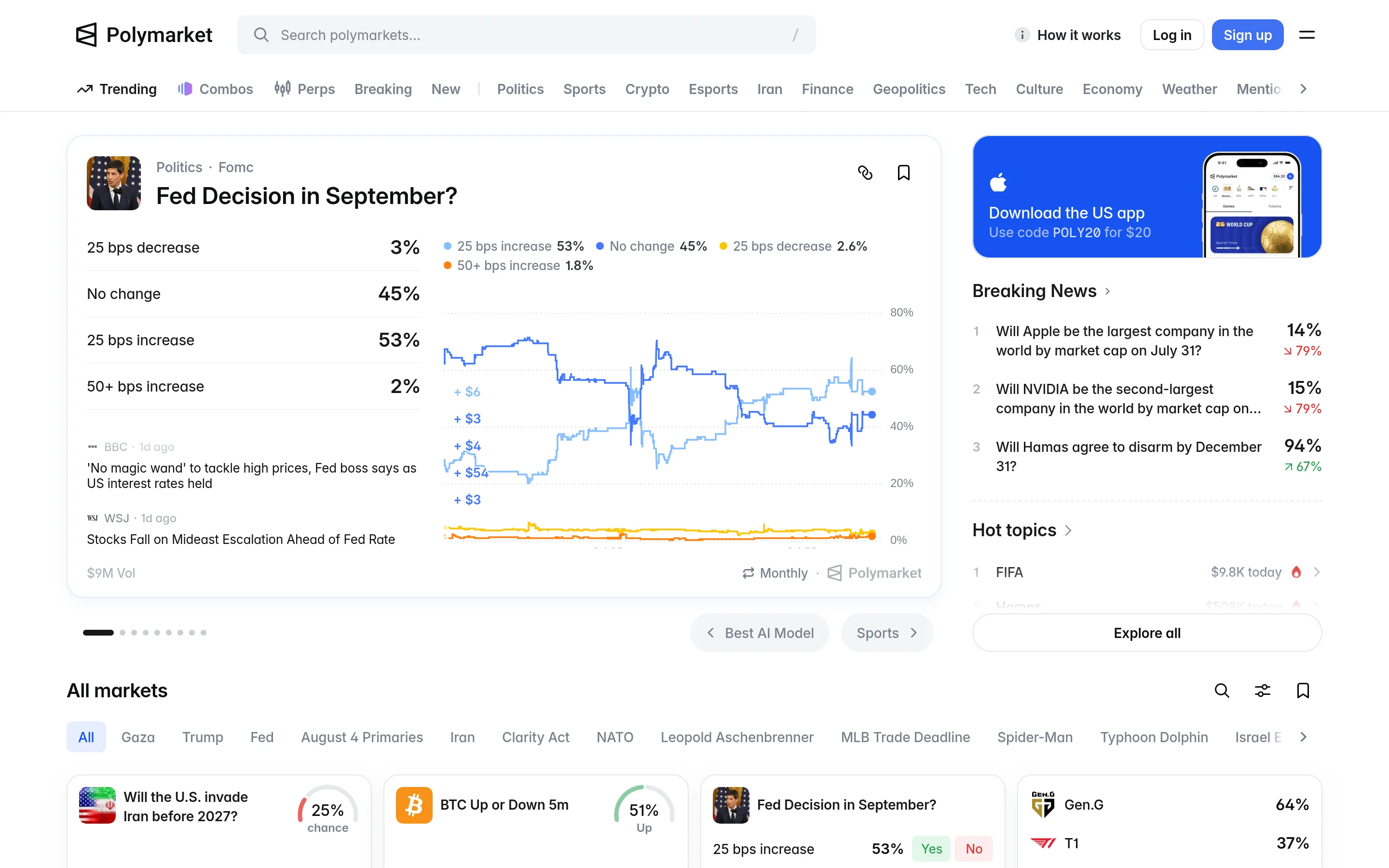
Polymarket grew up charging nothing to trade, but that changed: it now charges takers a fee shaped exactly like Kalshi's, highest near 50/50 odds and shrinking to nothing at the extremes. Makers pay zero and can earn rebates, which is the real structural difference between the two. Rates vary by category, and geopolitics and world-events markets remain fee-free. On top of the fee you still pay the spread, which widens on thin markets, plus the cost of moving money on and off crypto rails. Full breakdown in our Polymarket fees guide and Kalshi fees guide; both venues change pricing, so check the current schedules before you size a position.
On BitPredict the cost question is short: calling the market is free, and the optional Pro and Elite plans never touch scoring or rank.
Regulation and who can actually use each
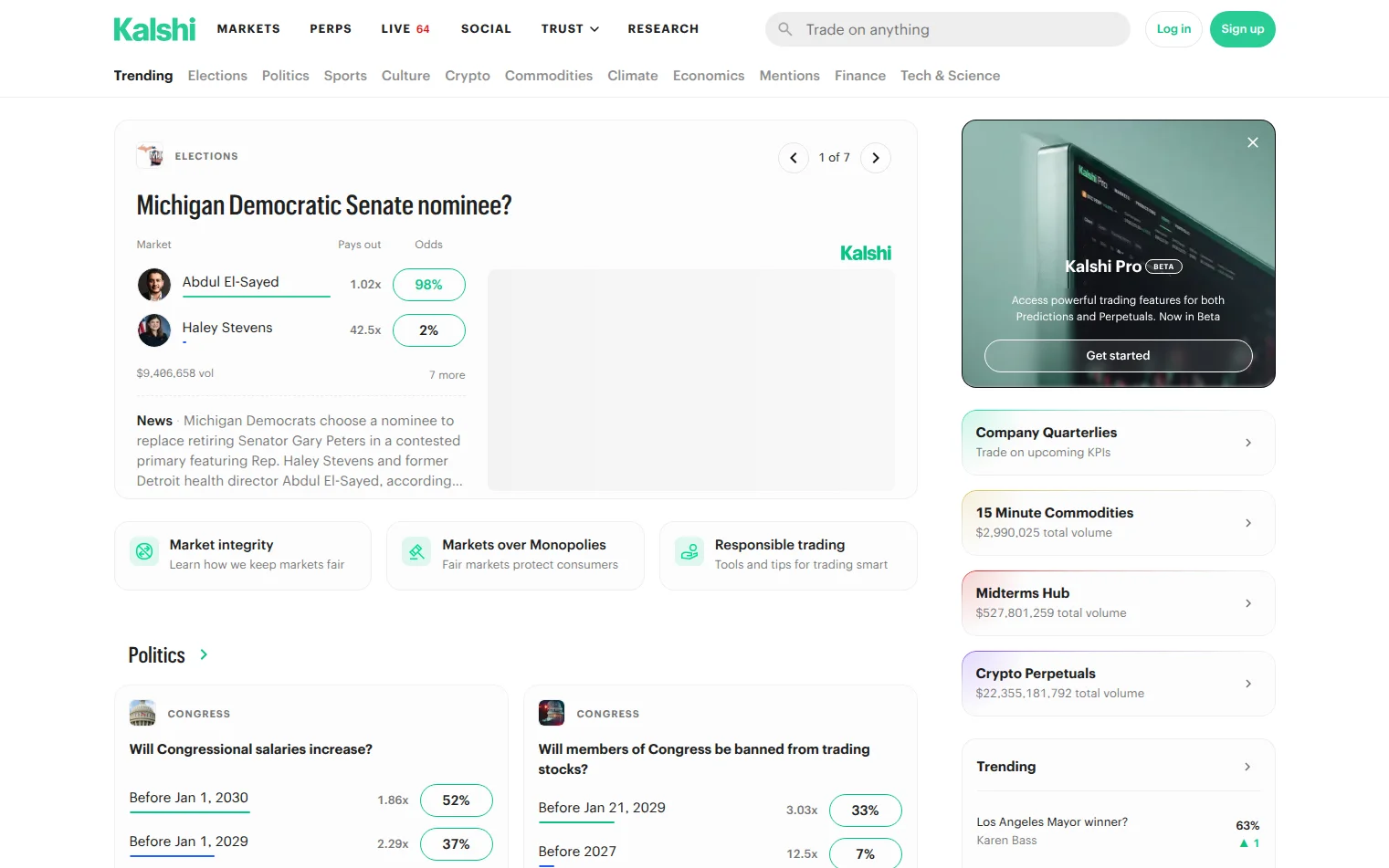
Kalshi is a CFTC-regulated exchange, which is its core pitch: US users trade a federally regulated product in dollars. Its expansion into sports markets has drawn legal challenges from some states, and those fights are still working through the courts, but the platform itself operates under federal oversight.
Polymarket spent years closed to US traders after a 2022 regulatory settlement, and became the global default everywhere else. In 2025 it acquired a CFTC-licensed exchange to re-enter the US onshore. Access and product details keep evolving on both platforms, so confirm what is available where you live before funding anything.
BitPredict sidesteps the question entirely: with nothing deposited and nothing wagered, there is no money-based access barrier. If you have wondered whether prediction itself counts as gambling, here is the breakdown.
Where each one wins
A fair comparison names winners by row, not overall. Kalshi and Polymarket each have categories the other simply does not match. Kalshi wins on:
- Regulated dollar rails: fund from a bank account, withdraw to a bank account, get standard US tax forms.
- US-specific markets: economic data prints, Fed decisions, weather, and a broad slate of sports event contracts.
- Rule clarity: outcomes resolve against an in-house rulebook rather than a token-holder vote.
- Comfort for users who will not touch crypto infrastructure at all.
Polymarket wins on:
- Liquidity and depth on the big global questions: elections, geopolitics, world events.
- Cost per trade if you post limit orders: makers pay no fee at all and can earn rebates, so patient traders can pay less than on Kalshi.
- Crypto-native settlement in USDC, a plus if you already hold stablecoins.
- Reach beyond the US: it is the default prediction market for a global audience.
On contested outcomes both models have tradeoffs. Kalshi's in-house rulings concentrate discretion in the exchange; Polymarket resolves through a decentralized oracle whose calls on ambiguous questions have occasionally been controversial. Read the market rules before you trade either.
The third option: prediction without the deposit
Most people comparing these two platforms are not professional traders. They have a read on the market and want to find out if it is right. If that is you, there is a version of this that costs nothing: BitPredict scores you on accuracy, not account size. Call any of 200 coins UP or DOWN over 24 hours. The call locks with a timestamp, settles against the real market price, and builds a public track record nobody can fake.
For the full platform-by-platform breakdowns, see our Kalshi alternatives and Polymarket alternatives guides, or browse every coin and make your first call now.
Frequently asked questions
Is Kalshi or Polymarket better?
Neither is better outright. Kalshi is the pick for regulated USD trading, bank funding, US tax forms and US-specific markets like economic data and sports. Polymarket is the pick for global market depth, no per-trade fees and crypto-native settlement. If you do not want money at risk at all, BitPredict is the free third option: you are scored on accuracy, not stake.
Is Polymarket legal in the US?
Polymarket was closed to US traders after a 2022 regulatory settlement, then acquired a CFTC-licensed exchange in 2025 to return to the US onshore. Rules and availability keep evolving, so check Polymarket's current status where you live before depositing.
Which has lower fees, Kalshi or Polymarket?
It depends on how you trade. Both now price trades the same shape: highest near 50/50 odds, shrinking to almost nothing at the extremes. The structural difference is that Polymarket charges takers only, so makers who post resting limit orders pay no fee at all and can earn rebates, while Kalshi charges makers a reduced fee rather than nothing. Polymarket also keeps geopolitics and world-events markets fee-free. Both publish current schedules and both change them, so check before trading. See our Kalshi fees and Polymarket fees guides for the arithmetic.
Can I use both Kalshi and Polymarket?
Yes, and many event traders do: Kalshi for regulated US markets like economic data and sports, Polymarket for global politics and world events. They are separate accounts with separate funding rails: dollars on Kalshi, USDC on Polymarket.
Do Kalshi and Polymarket use real money?
Yes. Both are real-money venues: you fund an account, buy positions in outcomes, and can lose your stake. That is the core difference from BitPredict, where predictions are free, nothing is staked, and the only thing on the line is your accuracy record.
Is there a free alternative to Kalshi and Polymarket?
Yes. BitPredict is a free crypto prediction game: call coins up or down over 24 hours, get scored on accuracy, and climb public leaderboards with zero money at risk. Manifold (play money) and Metaculus (forecasting) are free alternatives for non-crypto questions.