Crypto Fear & Greed Index
The Crypto Fear & Greed Index, Explained (and Put to Work)
The crypto Fear & Greed Index boils the market's mood down to a single number from 0 (extreme fear) to 100 (extreme greed). It's the fastest gut-check for whether the crowd is panicking or euphoric and, read against the grain, one of the most-watched contrarian signals in crypto. This guide covers what the index actually measures, how it's calculated, and how to read each zone. Then comes the part most explainers skip: turning that read into an accountable call. On BitPredict you can take the mood and make a free crypto prediction on where a coin goes next: timestamped, settled against the market, and scored on accuracy. Start with today's crypto predictions or size up Bitcoin directly.

What Is the Crypto Fear & Greed Index?
The crypto Fear & Greed Index is a 0–100 sentiment gauge that compresses several market signals into one daily number. A low reading means investors are fearful: selling, hoarding stablecoins, bracing for more downside. A high reading means they're greedy: chasing, leveraging up, afraid of missing the next leg. The most widely-cited version is published daily by alternative.me and is modeled on CNN's original stock-market index.
The idea rests on a simple behavioral observation: crypto markets are driven by emotion, and emotion tends to overshoot. Extreme fear often coincides with prices that have already been beaten down; extreme greed often shows up right before the froth comes off. That's why the index is usually read as a contrarian tool: Warren Buffett's "be fearful when others are greedy, and greedy when others are fearful," reduced to a dial.
How the Crypto Fear & Greed Index Is Calculated
The index isn't a single measurement: it's a weighted blend of market signals, each capturing a different facet of how fearful or greedy the crowd is. The exact weights vary by publisher, but the crypto index most people quote combines roughly these inputs:
| Signal | What it captures | Rough weight |
|---|---|---|
| Volatility | Current volatility and drawdowns vs. recent averages (spikes read as fear) | ~25% |
| Market momentum & volume | Buying volume and momentum vs. recent norms (heavy buying reads as greed) | ~25% |
| Social media | Post volume and engagement on crypto topics (unusual spikes read as greed) | ~15% |
| Surveys | Periodic sentiment polls (when active) | ~15% |
| Bitcoin dominance | Rising dominance can signal fear rotating out of altcoins into BTC | ~10% |
| Search trends | Google Trends for crypto queries (panic searches read as fear) | ~10% |
Because it leans on volatility and momentum, the index is largely backward- and present-looking: it describes conditions that have already printed on the chart. That's useful context, but it's not a forecast, which is exactly where an accountable call comes in later on this page.
How to Read It: From Extreme Fear to Extreme Greed
Readings are usually bucketed into four zones. The number matters less than the direction and the extreme: a market sliding into extreme fear behaves very differently from one grinding higher through greed.
| Reading | Zone | What the crowd is doing | Common contrarian read |
|---|---|---|---|
| 0–24 | Extreme fear | Panic selling, capitulation, cash on the sidelines | Historically where opportunity hides, but knives fall |
| 25–49 | Fear | Cautious, risk-off, quick to sell rallies | Accumulation zone for the patient |
| 50–74 | Greed | Confident, buying dips, leverage creeping in | Trend intact, but watch for froth |
| 75–100 | Extreme greed | Euphoria, FOMO, max leverage | Historically where tops form: trim, don't chase |
Two cautions. First, the index can stay pinned at an extreme for weeks in a strong trend: "extreme greed" is not a sell signal on its own, and "extreme fear" is not a buy signal on its own. Second, it's a whole-market gauge, dominated by Bitcoin; a single altcoin can be euphoric while the index reads fear. Use it as weather, not a trade trigger.
How to use the fear and greed index
Knowing what the number means is the easy half. Using it without fooling yourself is the harder half, and it comes down to four rules:
- Read extremes against the grain. Extreme fear tends to arrive after prices have already fallen, and extreme greed after they've already run. So the index is most useful as a contrarian prompt: a reason to look for a turn, never proof that one is coming.
- Never act on the index alone. It's built from volatility and volume that have already printed, so it describes the last few days, not the next few. Treat any reading as one input that needs confirmation from price action, news, or your own analysis before it becomes a decision.
- Watch zones, not single readings. Extremes cluster: the index can sit in extreme greed for weeks during a strong trend. Ten straight days pinned above 75 says far more than one afternoon's spike, so track how long the market has lived in a zone rather than reacting to each daily print.
- Pair the mood with your own directional call. The index tells you how the crowd feels; it never tells you what a coin does next. The useful move is to form your own view of where price goes from here and treat the reading as context for it.
That last rule is what makes the other three stick, because a directional call is checkable and a vibe is not. Say the index prints extreme fear and your read is that the selling is exhausted: that's a call that a coin closes higher tomorrow, and you can put it on the record in today's crypto predictions and find out. Do that through a few fear-and-greed cycles and you'll know something most index-watchers never learn: whether your contrarian read actually beats a coin flip.
Fear & Greed vs. BitPredict's Crowd Sentiment
The Fear & Greed Index tells you how the market feels today, distilled from price, volatility and volume. BitPredict measures something different and complementary: what the crowd is actually calling next, per coin, with receipts. Every prediction is a directional commitment (up or down, timestamped and later settled), so the aggregate is a forward-looking conviction signal, not a mood ring derived from the tape.
- Fear & Greed = one number for the whole market, backward-/present-looking, built from volatility and volume.
- BitPredict crowd sentiment = per-coin UP vs DOWN conviction, forward-looking, and every voice has a track record.
- Together = read the mood with the index, then see whether the crowd's calls confirm or fade it, and whether the accurate predictors agree.
That accountability is the difference. Anyone can shout "extreme greed, top is in" on social media with nothing at stake. On BitPredict a call is locked and scored, so the most accurate predictors earn credibility the index can't confer. Sentiment you can verify beats sentiment you can only feel.
Is the crowd right when it's sure? The Crowd Calibration Curve
Every explainer on this page, ours included, calls the index a contrarian tool. That is a testable claim, and BitPredict is in the rare position of being able to test it: every call on the platform is timestamped, settled against the real price, and tagged with how one-sided the crowd was when it opened. As of September 6, 2026 that is 4,147 settled calls. Bucket them by crowd agreement and you get the Crowd Calibration Curve:
Share of live open calls betting the coin ends higher, across every asset.
- Crowd hit rate
- 50.5%
- +0.5 points against a 50% coin flip
- Calls graded
- 4,147
- Every one settled against the market price, from 90 predictors
- Herd Rate
- 53.4%
- 682 calls made with a 70%+ one-sided crowd
- Fade Rate
- 51.4%
- 621 calls made against a 70%+ crowd
Does a more one-sided crowd land more often?
Point size is the number of settled calls behind each rate. Green is at or above 55%, red at or below 48%. A band with fewer than 10 settled calls shows no rate at all.
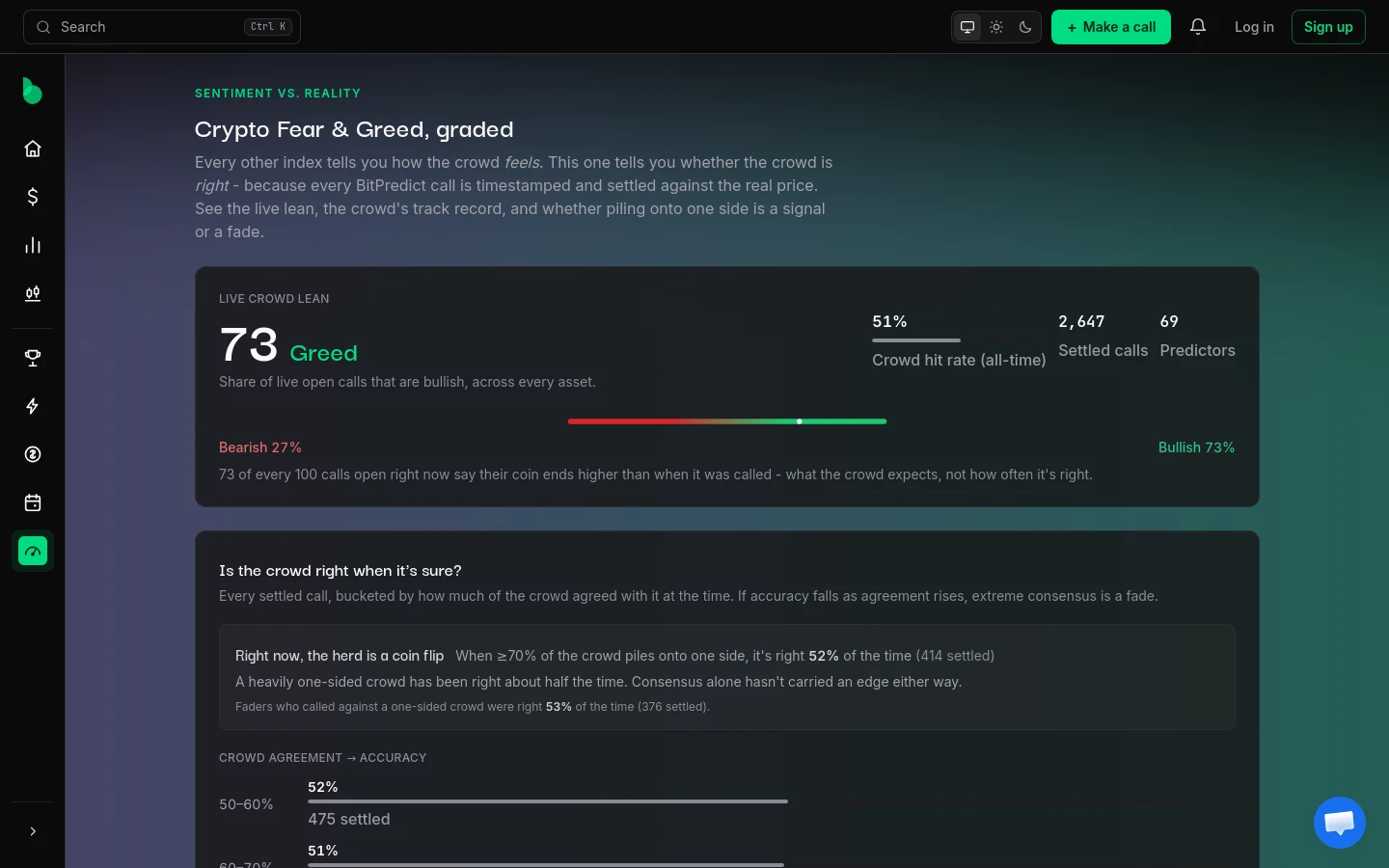
Right now, the herd is a coin flip. When 70% or more of the crowd is on one side, the call lands 53.4% of the time across 682 settled calls. Consensus has not carried an edge either way. Calls made against a crowd that one-sided landed 51.4% of the time (621 settled).
Source: app.bitpredict.io/api/public/stats/crowd-index. Snapshot from September 6, 2026; the committed figures on this page are rebuilt daily and refreshed live in your browser.
Right now calls made with a 70%+ one-sided crowd land 53.4% of the time, and calls made against one land 51.4%, which makes consensus a coin flip by our rules. That is our read on "extreme greed means a top": for this crowd, the mood is a measure of crowding rather than a forecast. The full method, the per-coin board and the raw data are in how accurate crypto predictions really are.
Turn Today's Reading Into a Call
A reading is only worth as much as what you do with it. The move isn't to trade on the number blindly. It's to form a view and put it on the record. Think the extreme-greed print means Bitcoin cools off? Call Bitcoin down over the next 24 hours. Think fear is overdone on a major? Call Ethereum or Solana up. Either way, it settles automatically and your accuracy is the only score that counts.
No wallet, deposit, or dollar required: this is a free, no-money way to test your read. New here? Browse the full list of coins to predict, see how BitPredict compares in our best crypto prediction sites roundup, or read what a prediction market is if the concept is new.
Frequently asked questions
What is the crypto Fear & Greed Index?
It's a 0–100 gauge of overall crypto market sentiment, where 0 is extreme fear and 100 is extreme greed. It blends signals like volatility, momentum and volume, social media, Bitcoin dominance and search trends into a single daily number, and is most often read as a contrarian tool: extreme fear can flag opportunity, extreme greed can flag risk.
What is a good Fear & Greed Index reading?
There's no universally "good" number. It depends on your strategy. Contrarians often see extreme fear (0–24) as a potential accumulation zone and extreme greed (75–100) as a time for caution. But the index can stay at an extreme for weeks during a strong trend, so it's context, not a standalone buy or sell signal.
How often does the crypto Fear & Greed Index update?
The widely-cited crypto index updates daily. Because it's built largely from volatility and volume, it mostly describes conditions that have already happened: useful as market weather, but not a forecast of where prices go next.
Is the Fear & Greed Index accurate?
It accurately summarizes current market emotion, but it doesn't predict prices, and it's a whole-market gauge dominated by Bitcoin: a single altcoin can move against it. Treat it as one input among many, not a crystal ball.
How do you use the crypto fear and greed index?
Most practitioners use it as a contrarian context check: extreme fear flags a market that may be oversold, extreme greed flags froth. It works best paired with your own directional view rather than as a standalone trigger, because extremes can persist for weeks in a strong trend. Watch which zone the index sits in over days and weeks instead of reacting to single readings, and confirm with price action or news before acting on it.
Does BitPredict have a fear and greed signal?
BitPredict shows something complementary: real, forward-looking crowd sentiment per coin (the share of users calling an asset up vs down), where every prediction is timestamped, settled, and tied to a public accuracy record. You can read the market's mood with the Fear & Greed Index, then check whether BitPredict's crowd calls (and its most accurate predictors) confirm or fade it.