Crypto betting
Crypto betting means four different things, and only one of them costs nothing to try.
Search for crypto betting and one results page mixes casino ads, futures exchanges and prediction markets. They are not the same product. This page explains what each one is, what a wrong call costs on each, where the law stands in plain words, and how to try the price-betting part with nothing staked on BitPredict.

Crypto betting is a loose phrase, and it covers four different products.
Two different things get called crypto betting. One is betting with crypto: a casino or sportsbook that takes Bitcoin or stablecoins as payment, where the bet is on a game or a match. The other is betting on crypto: a position on whether a coin's price goes up or down. Most people who search the phrase mean the second, and the second splits again by what you put in and what you can lose.
What a wrong call costs on each route
- Who is on the other side
- Nobody: calls are scored, not matched
- A wrong call costs
- A miss on your public record
- Who is on the other side
- Another trader
- A wrong call costs
- The price you paid, plus the fee
- Who is on the other side
- Another trader
- A wrong call costs
- Up to the whole margin, through liquidation
- Who is on the other side
- The house
- A wrong call costs
- The whole bet, at odds the house sets
Three of the four are ways to bet on a price. The fourth, the casino, is a bet where the price of Bitcoin plays no part, which is why it is covered last and shortest.
The same Bitcoin call costs very different amounts on each route.
Take one view: Bitcoin ends the day higher. Here is what that view costs on three routes, with round numbers so you can check the arithmetic yourself.
| Prediction market | Leveraged futures |  BitPredict | |
|---|---|---|---|
| What you put in | $40 buys 100 contracts at 40 cents each | $100 of margin at 10 times leverage, a $1,000 position | Nothing |
| If Bitcoin ends higher | Each contract pays $1, so you collect $100, a $60 gain before fees | A 2% rise makes $20 before fees | A hit on your public record |
| If Bitcoin ends lower | The contracts expire at zero and you lose the $40 | A 2% fall loses $20 before fees | A miss on your public record |
| The worst case | The $40 you paid, plus fees | A 10% fall erases the whole $100 margin | A lower hit rate, and nothing else |
The difference in the last row is leverage. A contract caps your loss at its price. A futures position multiplies the move, and in rough terms a 10% move against you at 10 times leverage uses up the margin, with exchanges usually closing the position a little before that. Paper trading keeps the question (which way will it go) and removes the loss.
A prediction market contract turns a crypto price question into something you buy for under a dollar.
A prediction market sells yes or no contracts on a defined outcome, such as whether Bitcoin finishes the day above a set price. The contract costs between zero and a dollar and pays $1 if you were right. A price of 40 cents means the market is treating the outcome as roughly 40% likely, so buying it is a bet that the true chance is higher.
Fees are real and they differ by venue. Polymarket's documentation charges only the side that takes an order, at a rate set by category: 0.07 for crypto, applied as fee = shares × rate × price × (1 - price) (Polymarket fees, read November 2026). For 100 shares at 40 cents that is 100 × 0.07 × 0.4 × 0.6, which is $1.68. Kalshi's help centre says it charges a transaction fee on the expected earnings of the contract, and that fees vary by market (Kalshi fees, read November 2026). Robinhood's support article says its event contracts come from partner exchanges, with a Robinhood commission of at most $0.01 per contract plus an exchange fee of up to $0.01 per contract (Robinhood support, read November 2026).
Every venue, with the rival facts sourced one by one, is on the best prediction markets page, and the model itself is explained in what is a prediction market.
Leveraged futures multiply every move, which makes them the quickest way to lose a margin.
A futures contract tracks a coin's price and lets you borrow exposure against a deposit called margin. The bet never settles at a set time: every tick changes your profit or loss, there are periodic funding payments between long and short traders, and a move against you big enough to eat the margin closes the position on its own, which is called liquidation.
That structure suits traders who manage risk all day. It is a poor way to find out whether your read on direction is any good, because leverage, fees and funding blur the answer. Whether a call was right and whether it made money stop being the same question.
Casinos and sportsbooks that take crypto are a different business with a different set of risks.
A casino or sportsbook that accepts Bitcoin is a house taking the other side of your bet, at odds it sets. Crypto is only the way you pay. Licences come from gambling authorities that differ from country to country, and an operator licensed somewhere else can leave a player with little recourse when a payout goes wrong.
If your actual question is whether predicting a price counts as gambling at all, that has its own answer in is crypto prediction gambling.
The law treats these products differently, so whether crypto betting is legal depends on which one you mean.
This is a plain-words map, not legal advice, and the venues' own terms move faster than any article.
- Prediction markets. Kalshi says it is regulated by the CFTC (the US derivatives regulator) as a designated contract market (Kalshi help centre, read November 2026). Polymarket's developer documentation lists the United States as close-only, meaning users can close existing positions but cannot open new ones, on its website and its API (Polymarket docs, read November 2026). Robinhood says you need an approved account and US residence, and that event contracts are not available in all states (Robinhood support, read November 2026).
- State rules. Several states have acted against real-money prediction markets, and the list changes often. The sourced list is on prediction markets by state.
- Leveraged futures. Rules differ by country and by exchange, and an exchange that does not serve your country is not a place to deposit.
- Casinos and sportsbooks. They depend on gambling licences that differ by country, and many do not cover the US.
- Paper trading. Nothing is staked, so there is no wager to regulate. The reasoning is in is crypto prediction gambling.
BitPredict paper trading lets you bet on a coin's direction with nothing at stake.
On BitPredict you pick a coin and call it up or down over the next 24 hours. The call locks the moment you make it, with a timestamp, and settles on its own against the real market price. There is no deposit, no wallet and no contract to buy. If you want the longer version of the idea, it is on the paper trading crypto page.
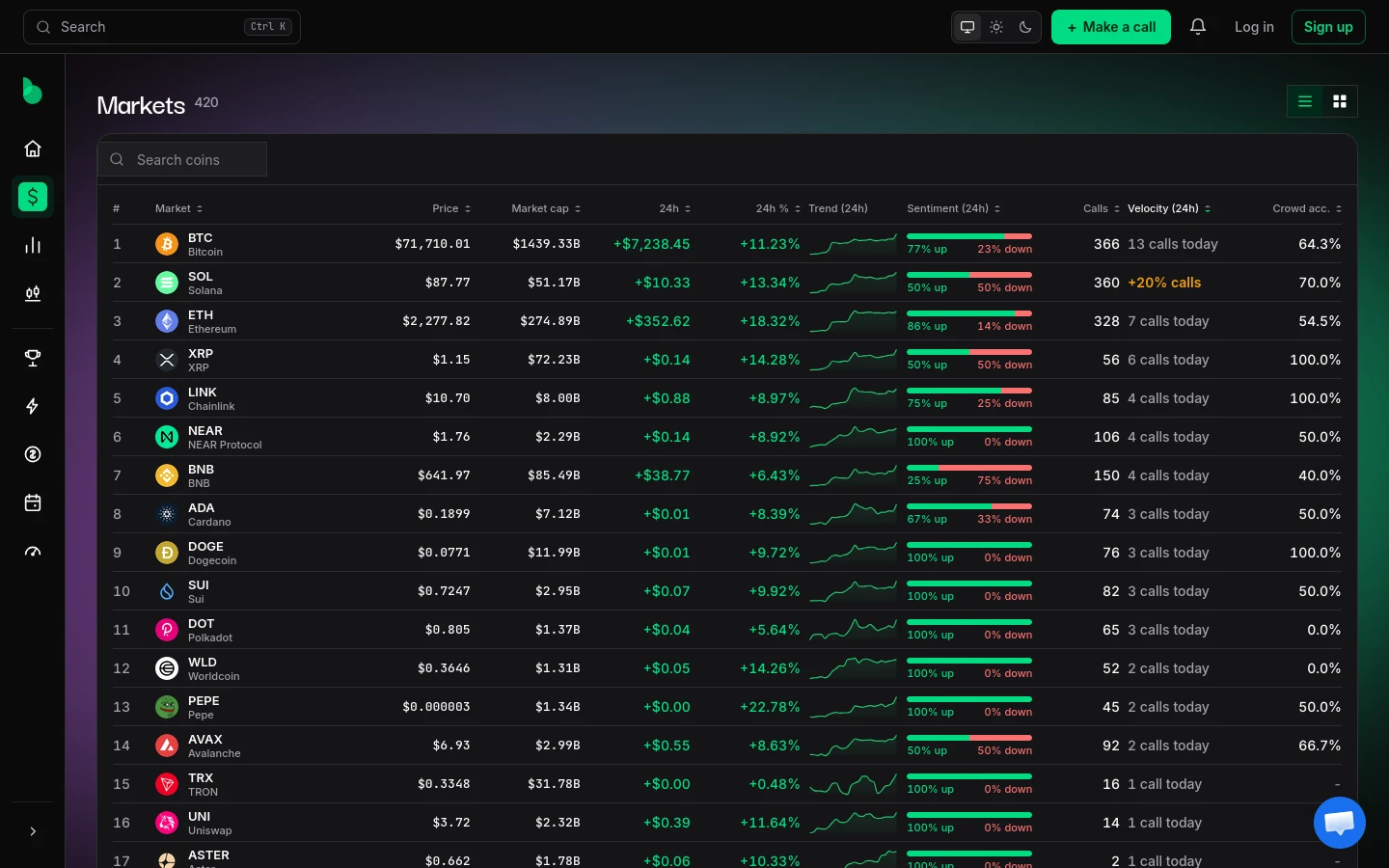
It is a scoring game, and you cannot win money on it. That is the trade: the payout goes, and so does the loss. Every settled call feeds a public hit rate on the crypto leaderboard, so after a few weeks you can see whether your reads beat a coin flip, which a funded account answers badly because position size and fees blur the result.
Which route fits depends on what you want from the bet.
- You want a payout on an event, with a known worst case: a prediction market, after checking the venue's fees and whether you can use it from where you live.
- You want leveraged exposure and can manage the risk of liquidation: regulated futures, sized far below what feels natural.
- You want to know whether your read on direction is any good: paper trade it first. If your hit rate cannot beat a coin flip when it is free, money will not improve it.
- You want a casino: that is gambling on a game, it has nothing to do with the price of a coin, and it is outside what this site covers.
Frequently asked questions
What is crypto betting?
It is a loose phrase for four different things: a prediction market contract on a crypto price, a leveraged futures position, a casino or sportsbook that takes crypto as payment, and free paper trading where you call a price up or down with nothing staked.
Is crypto betting legal?
It depends on the product and on where you live. Kalshi says it is regulated by the CFTC as a designated contract market, Polymarket's documentation lists the United States as close-only, and Robinhood limits event contracts to US residents in states where they are available. Casinos depend on gambling licences that differ by country. This is not legal advice, so check the venue's own terms.
Can you bet on crypto without money?
Yes. On BitPredict you call any listed coin up or down over 24 hours, the call locks with a timestamp, and it settles against the real market price. Nothing is staked, and your accuracy goes on a public record.
Is a prediction market the same as crypto betting?
A prediction market is one of the ways to bet on a crypto price. It sells yes or no contracts that pay $1 if the outcome happens, so the most you can lose is the price you paid. Futures and casinos work differently.
Is BitPredict a betting site?
No. There are no deposits, no odds and no payouts, so there is no wager. You make calls on prices, they are scored on accuracy, and the score is public.
How is BitPredict free?
Playing costs nothing because nothing is staked. The product earns from optional Pro and Elite subscriptions that add analytics and real-time access, and neither is needed to play or to rank.