Polymarket review
Polymarket review: is Polymarket legit?
Short answer: yes, Polymarket is legitimate, and it is the largest prediction market in the world by volume. It is not a scam, the markets are real, and payouts happen. What it is not is a US-regulated brokerage in the way Kalshi is, and its history with US access is genuinely complicated. This review covers what Polymarket is, the fees it now charges (a lot of pages still wrongly say it is free), how resolution actually works, where it beats every alternative, and the risks worth understanding. Written by the team behind BitPredict, a free prediction game, so our bias is stated in the last section.

Is Polymarket legit? The straight answer


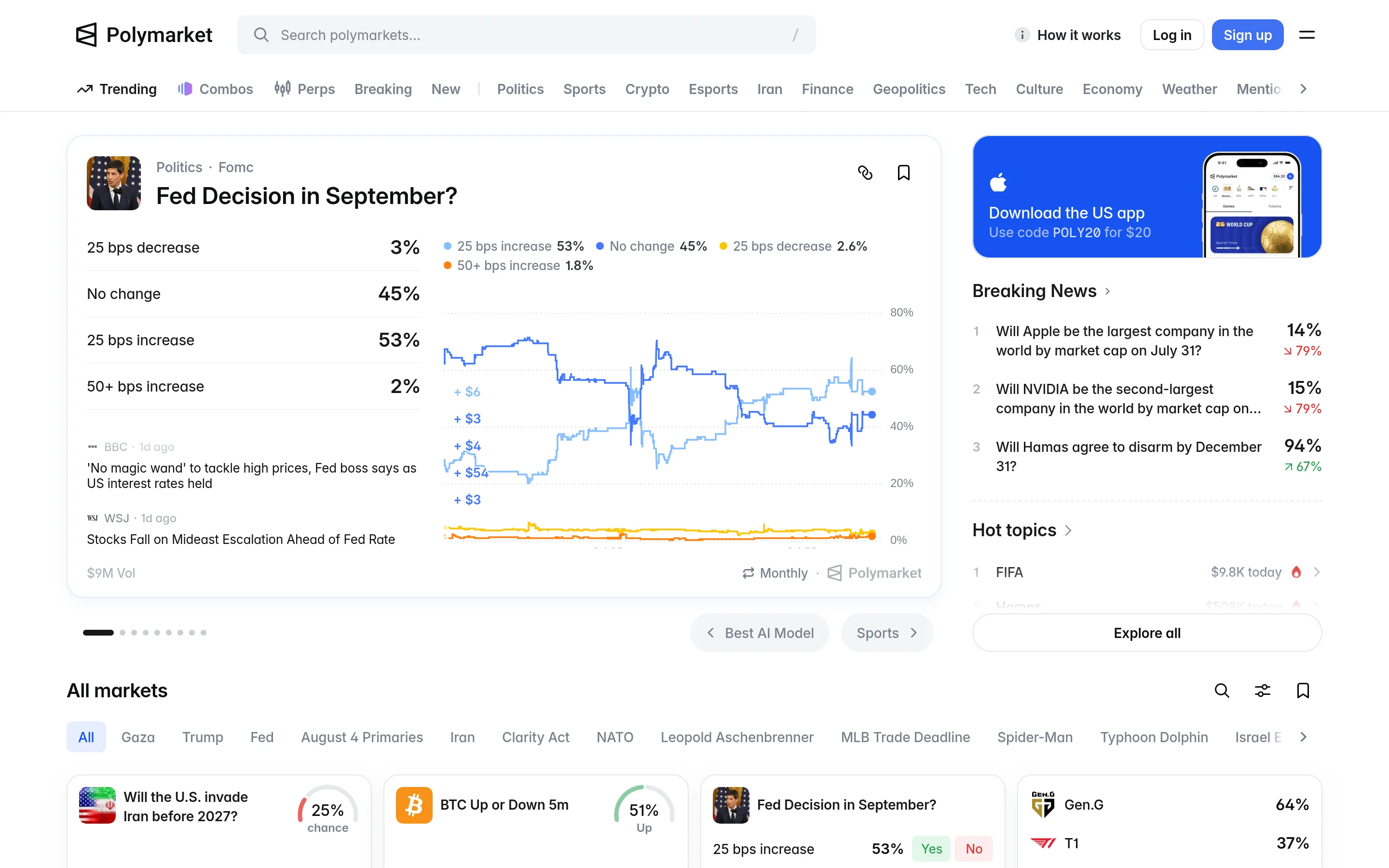
Polymarket is a real, functioning prediction market with the deepest liquidity in the category, particularly on elections, geopolitics and world events. Its prices are quoted by mainstream news outlets as a probability signal. Markets settle and winners get paid. On the basic question of whether it is a scam, the answer is no.
The nuance is regulatory. Polymarket was closed to US traders following a 2022 regulatory settlement, and became the global default everywhere else. It subsequently acquired a CFTC-licensed exchange in order to re-enter the US onshore. Access rules have been changing, so the single most important thing to check before depositing is what is actually available to you where you live, on Polymarket's own site, today.
What Polymarket actually is
- A crypto-native prediction market. You buy and sell shares in outcomes; a winning share pays $1, a losing one pays nothing.
- Settled in USDC, a dollar stablecoin, rather than in bank dollars.
- Global. Its depth on international politics and world events is unmatched by any regulated US venue.
- Resolved by a decentralised oracle rather than an in-house rulebook.
- Broad in scope: politics, geopolitics, sports, crypto, culture, economics and more.
What it costs now (this changed)
Polymarket built its reputation on charging nothing to trade, and a great many articles still repeat that. It is no longer accurate. Polymarket now charges a taker fee that varies by category, using the formula shares × rate × price × (1 − price). Rates run from 0.04 on politics, finance, tech and mentions up to 0.07 on crypto.
Two things soften that considerably. Makers are never charged, and can earn rebates of 15% to 25% for providing liquidity. And geopolitics and world-events markets remain completely fee-free, which Polymarket states explicitly. The full per-category table is in our Polymarket fees guide.
The cost that matters most is still the one no schedule lists: the spread, plus whatever it costs you to move money on and off crypto rails.
How resolution works, and where it gets contentious
Polymarket resolves markets through a decentralised oracle rather than an in-house rulebook. On clear questions this works fine and settles quickly. On genuinely ambiguous questions, where the wording and the real world do not line up neatly, some resolutions have been contested and publicly argued over.
This is a real structural difference from Kalshi, and neither model is strictly better. Kalshi concentrates discretion in the exchange; Polymarket distributes it to token holders. Read the resolution criteria of any market before you trade it, especially on questions whose wording could plausibly be read two ways.
Where Polymarket genuinely wins
- Liquidity and depth on the big global questions. Nothing else in the category is close on elections and geopolitics.
- Whole fee-free categories. Geopolitics and world events carry no trading fee at all.
- Makers pay nothing and earn rebates, so patient traders can be paid to provide liquidity.
- Cheaper on politics than Kalshi, at a 0.04 coefficient against 0.07.
- Genuinely global reach, rather than a US-only product.
- Tight spreads on popular markets, which usually matters more than the fee line.
- Crypto-native settlement, a real convenience if you already hold stablecoins.
If you want to trade world events with real money and you are comfortable on crypto rails, Polymarket is the best venue in the category. BitPredict does not compete with that and does not pretend to.
The real risks and downsides
- You can lose your whole position. Outcome shares go to zero when you are wrong.
- Crypto rails are friction and risk. Wallets, stablecoins and bridges all add steps and failure modes if you do not already live on-chain.
- Resolution disputes happen on ambiguous questions, and the oracle's call is the one that counts.
- US access has a complicated history and the rules keep evolving, so verify your own eligibility rather than assuming.
- Fees now exist where they did not before, and may change again.
- No US tax paperwork is handed to you. Tracking your own crypto tax position is your problem.
Is Polymarket worth it? Who it fits
- Worth it if you want the deepest markets on global politics and world events, and you already hold stablecoins.
- Worth it if you post resting limit orders, since makers pay nothing and earn rebates.
- Worth it if you trade geopolitics, where there is still no fee at all.
- Probably not worth it if you want bank funding, US tax forms and no crypto exposure. That is Kalshi's job.
- Not worth it if you only want to know whether your read on a market is good. You do not need money at risk to answer that.
Our bias, stated plainly
We make BitPredict, a free crypto prediction game with no deposits, no wagering and no trading profits. We benefit if you try the free option, and you should read this review with that in mind.
The honest division: to trade world events for money, Polymarket is the best venue available and we are not an alternative to it. To find out whether you can call crypto, and keep a public record that proves it, BitPredict does that for nothing. See our Polymarket alternatives roundup, the Kalshi vs Polymarket head-to-head, or our pricing, which is free.
 PolymarketCrypto-native · USDC
 KalshiRegulated US exchange
 RobinhoodEvent contracts in-app
 PredictItUS politics markets
 ManifoldPlay-money markets
 MetaculusForecasting community
 BitPredictFree · scored on accuracy
Frequently asked questions
Is Polymarket legit?
Yes. Polymarket is the largest prediction market in the world by volume, its markets resolve and winners are paid, and its prices are widely quoted as a probability signal. It is not a US-regulated brokerage in the way Kalshi is, and its US access has a complicated history, so check what is available to you where you live before depositing.
Is Polymarket safe?
The platform functions and pays out, but safe is doing a lot of work in that question. You can lose a position entirely, funds sit in USDC on crypto rails rather than a bank, and ambiguous markets are resolved by a decentralised oracle whose calls have sometimes been contested. Read a market's resolution criteria before trading it.
Does Polymarket charge fees now?
Yes, which is a change many articles have not caught up with. Takers pay a fee that varies by category, calculated as shares × rate × price × (1 − price), with rates from 0.04 to 0.07. Makers are never charged and can earn rebates, and geopolitics and world-events markets remain entirely fee-free.
Is Polymarket legal in the US?
Polymarket was closed to US traders after a 2022 regulatory settlement, then acquired a CFTC-licensed exchange to re-enter the US onshore. Availability has been changing since, so confirm the current position on Polymarket's own site for your location before funding anything.
Is Polymarket or Kalshi better?
Neither outright. Polymarket wins on global market depth, fee-free geopolitics, cheaper politics and zero maker fees. Kalshi wins on US regulation, dollar bank funding, tax paperwork and US-specific markets like economic data and weather. Many people use both. Our Kalshi vs Polymarket page compares them row by row.
Is there a free alternative to Polymarket?
BitPredict is a free crypto prediction game where you call a coin up or down over 24 hours and are scored on accuracy, with nothing deposited or staked. Manifold runs play-money markets and Metaculus scores forecasting accuracy. None of them pay trading profits, which is exactly the trade-off for being free.