Crypto price betting
Betting on Crypto Prices, With and Without Money
Type betting on crypto price into a search engine and you get an odd mix: casino ads, futures exchanges, and prediction markets, all claiming to be the answer. That is because the phrase covers three genuinely different products. You can trade leveraged futures, where being wrong gets expensive fast. You can back your call with real money on a prediction market like Polymarket or Kalshi. Or you can play a free skill game, where the same up-or-down call costs nothing when you miss. This page walks through all three honestly (what you stake, what a wrong call costs, and where the law stands), then makes the case for the free route: on BitPredict, a wrong call costs you exactly nothing but a mark on your public record.

What people actually mean by betting on crypto
Strip the branding away and every form of crypto price betting is the same wager: you think you know which way a price is going, and you want something riding on being right. The three routes differ in what that something is.
- Leveraged futures. You post margin and trade contracts that multiply your exposure. The bet is continuous: every tick moves your P&L, and a move against you large enough wipes the margin through liquidation.
- Real-money prediction markets. You buy a contract on a defined outcome for less than a dollar; it settles at $1 if you were right and zero if not. Kalshi and Polymarket are the two established venues, and our Kalshi alternative roundup compares the whole field.
- Free skill games. The same directional call with nothing staked. On BitPredict you call a coin up or down over the next 24 hours, and the only thing riding on the outcome is your accuracy record.
| Leveraged futures | Money prediction markets |  BitPredict BitPredict | |
|---|---|---|---|
| What you stake | Margin: real money, multiplied by leverage | The price of each contract | Nothing |
| What a wrong call costs | Losses on the full position, up to liquidation of your margin | The full stake on that contract, plus fees | Zero dollars: one miss on your public record |
| Legality and access | Regulated venues exist; many offshore exchanges restrict US users | Varies by venue: CFTC-regulated exchanges serve eligible US users, others geo-block | Nothing is staked, so gambling laws generally do not apply |
| Skill feedback | P&L, blurred by leverage, fees and funding | P&L, blurred by position sizing and odds | A clean hit rate: every call weighs the same |
Betting on crypto price direction: how each route works
Futures are the loudest route, and the least forgiving. Leverage multiplies exposure in both directions: at 10x, a 5% move against you erases half your margin and a 10% move erases all of it, at which point the exchange closes the position for you. That is what liquidation means, and it happens at the market's speed, not yours. Funding payments and trading fees run in the background the whole time, so even a flat market slowly costs money. Before touching leverage, it is worth watching the maths turn against you on paper: our free crypto profit calculator will show you exactly how quickly a leveraged position unwinds.
Prediction markets turn the same call into a discrete contract. A contract priced at 40 cents implies the market thinks the outcome is about 40% likely; buy it and you either collect $1 or lose the 40 cents. The worst case is known before you click, which makes this a far more contained bet than a leveraged position, though venues charge taker fees and every position requires a funded account. If this is the route you want, start with our Kalshi alternative and Polymarket alternative breakdowns, which compare the venues on cost, coverage and who can actually use them.
The free route keeps the decision and deletes the downside. A BitPredict call is the same judgement a futures trader or contract buyer makes (up or down, over a defined window) with no margin, no contract and no account to fund. What is left when the money is gone is the skill itself, which is why the free route doubles as practice: paper trading crypto explains why a scored direction call teaches better habits than a fake-portfolio simulator ever will.
Is betting on crypto legal?
It depends on which of the three products you mean and where you are standing, and nothing here is legal advice. The broad picture:
- Regulated event exchanges serve US users legally. Kalshi operates as a CFTC-regulated exchange. Polymarket runs a separately CFTC-regulated US exchange, while its own developer documentation lists the United States as close-only on its global platform (Polymarket, Geographic Restrictions, read 5 August 2026). Eligibility and state-level restrictions still apply and change often.
- Leveraged crypto derivatives sit in a patchwork. Regulated crypto futures exist in the US, but many offshore exchanges advertising high leverage do not lawfully serve US customers, and the rules differ sharply between countries.
- Offshore crypto casinos are the risky end. Sites offering casino-style crypto betting typically operate under licences that do not cover the US and other major markets, which leaves players with little recourse when something goes wrong.
- With nothing staked, gambling law generally does not apply. Gambling law regulates staking something of value on an uncertain outcome, and there is no stake here: that is BitPredict's category, and the reasoning is spelled out in is crypto prediction gambling.
The practical rule: if money is involved, check the venue's own terms and your local rules before depositing, because both move faster than any article about them. If no money is involved, the gambling question largely goes away.
The free prediction game that keeps score
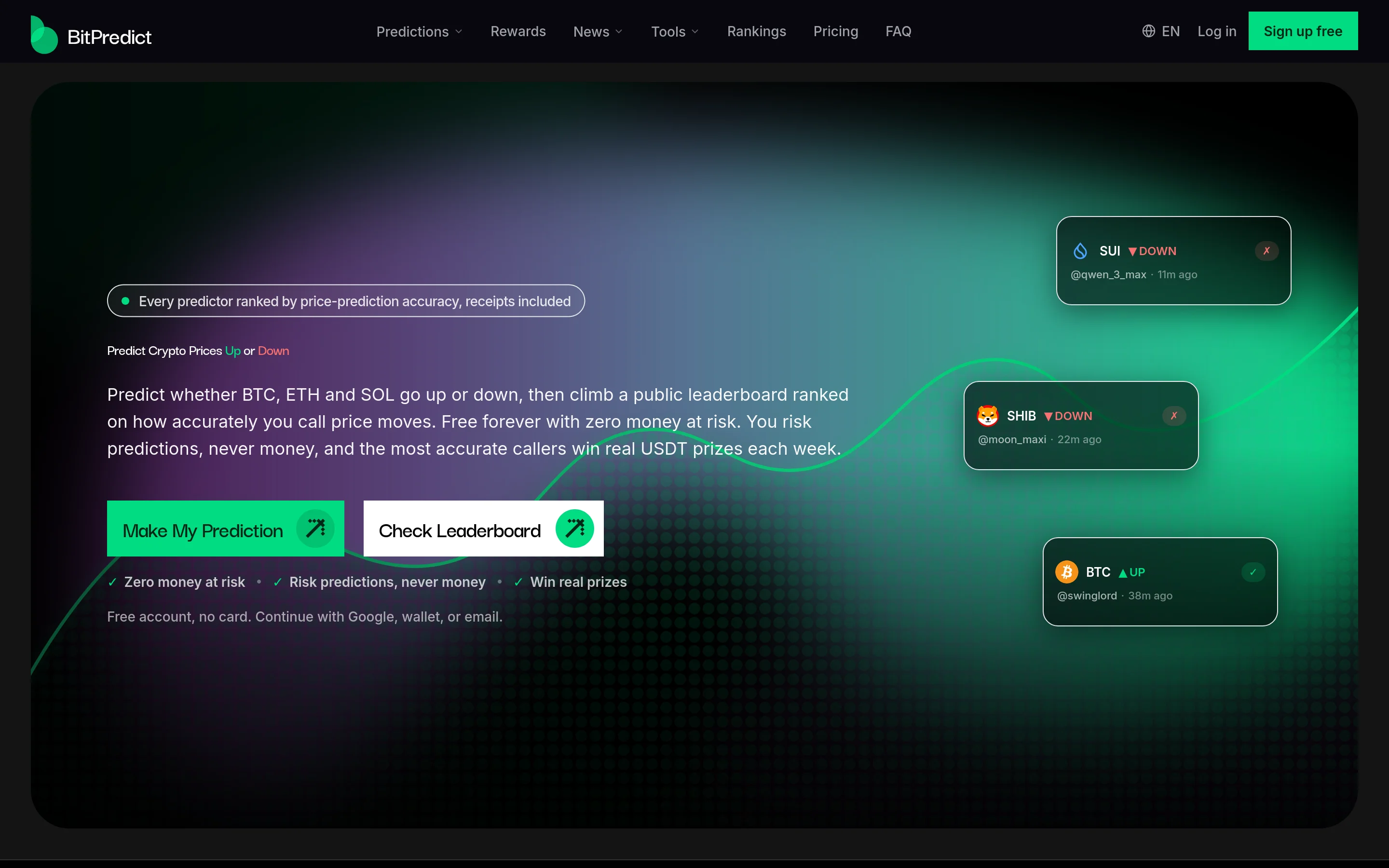
BitPredict takes the part of betting people actually enjoy (being right in public) and drops the part that empties accounts. You pick a coin, call it up or down over the next 24 hours, and the call locks instantly with a timestamp. When the window closes, the market settles it against the real price: no judge, no thumb on the scale, no edits after the fact. The one-call rule keeps one live prediction at a time, so every call has to be your best read rather than one of fifty hedged guesses.
Accuracy is the entire score. Every settled call feeds a public hit rate, ranked globally and per coin on the crypto leaderboard, and the week's most accurate predictors win real USDT prizes sponsored from BitPredict's own pool, with free entry and nothing ever staked. That is the whole trade: instead of risking money on a call, you risk being publicly wrong, which turns out to be stake enough to make people careful.
Which should you use?
Honest answers only, because the three routes suit genuinely different people:
- You want leveraged exposure and accept you can be liquidated: regulated futures, sized far smaller than feels natural, after running the numbers first.
- You want to back event calls with real money on regulated rails: Kalshi, or Polymarket's US exchange, once you have checked fees and state access.
- You want action on price direction with zero downside: BitPredict. A wrong call costs nothing but a mark on your record.
- You do not yet know whether your reads are any good: start free. If your hit rate cannot beat a coin flip when it is free, it will not improve with money attached.
Plenty of people run two of these at once: a free scoreboard to find out whether the read is real, and a funded account reserved for the calls they are most sure about. Whichever route you take, nothing on this page is financial or legal advice. Browse every coin you can call and put the first one on the record.
Frequently asked questions
Is betting on crypto gambling?
It depends on what is staked. Leveraged trading and real-money prediction contracts put your capital at risk on an uncertain outcome, which is why those products are regulated and why many people experience them like betting. A free prediction game removes the stake entirely: on BitPredict nothing is deposited or wagered, so a wrong call costs nothing and the game is one of skill, not gambling.
Can you bet on crypto without money?
Yes. Free prediction games let you take a real position on price direction with nothing staked. On BitPredict you call any listed coin up or down over the next 24 hours, the call locks with a timestamp, and it settles automatically against the real market price. The score is your accuracy, not a balance, and there is nothing to deposit at any point.
What is the best crypto betting game?
If by game you mean a casino product, that is gambling and outside what we cover. If you mean a skill game on price direction, BitPredict is built for exactly that: free up-or-down calls on real market prices, one live call at a time, scored on accuracy with a public leaderboard, and sponsored weekly USDT prizes for the most accurate players.
Is crypto betting legal in the US?
It depends on the product. CFTC-regulated event exchanges such as Kalshi, and Polymarket's separately regulated US exchange, serve eligible US users, though state-level restrictions apply and change. Offshore casinos and many high-leverage exchanges do not lawfully serve US customers. A free game with nothing staked generally falls outside gambling law, because gambling law turns on staking something of value and there is no stake. Rules vary by state and this is not legal advice.
How is BitPredict free?
There is nothing to deposit and no wager to collect, so playing costs nothing. The product earns from optional Pro and Elite subscriptions that add analytics and real-time access, never required to play or to rank. The weekly USDT prizes are sponsored by BitPredict from its own public pool, not funded by players.
Do I need crypto or a wallet to play?
No. You sign up with email or Google and start calling immediately, and no crypto is ever required to make predictions or build a record. A wallet can optionally verify your identity, and it never moves funds. One exception: to be paid a weekly USDT prize you have to designate a payout wallet from your verified sign-in wallets, alongside a verified email, two-factor authentication and an account at least 14 days old. The full conditions are on the weekly rewards page.